
 Medan Tour
Sahabatholidays.com – The history of Lake Toba is not just a local story about North Sumatra; it is a global saga that involves supervolcanoes, a near-extinction of the human race, and the birth of a unique island culture.
For travelers, knowing the history adds a profound layer of meaning to the view. You are not simply taking a selfie by a lake; you are standing inside the crater of a beast that once shook the world.
The story of Toba is split into two fascinating parts: the Geological History (science) and the Cultural History (legend). Both are essential to understanding the magic of this destination.
In this guide, Sahabat Holidays takes you on a journey through time. We explore the explosion that changed the planet, the legend of the goldfish princess, and how you can visit the sites that tell these incredible stories today.
The Scientific History – The Day the Earth Went Dark
The most critical chapter in the history of Lake Toba occurred approximately 74,000 years ago. At that time, Toba was a massive mountain.
1. The Super-Eruption (Youngest Toba Tuff)
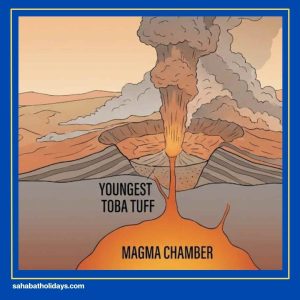
Geologists call it the “Youngest Toba Tuff” event. It wasn’t just an eruption; it was an apocalypse.
-
The Scale – It was a Volcanic Explosivity Index (VEI) 8 eruption—the highest rating possible. It was 100 times stronger than Mount Tambora (1815) and thousands of times stronger than Mount St. Helens.
-
The Debris – The mountain blasted roughly 2,800 cubic kilometers of rock, ash, and magma into the sky. To visualize this, imagine burying the entire United States under a thick layer of ash.
-
The Reach – Toba ash has been found as far away as India, the Middle East, and East Africa. In India, the ash layer was up to 6 meters thick!
2. The Volcanic Winter
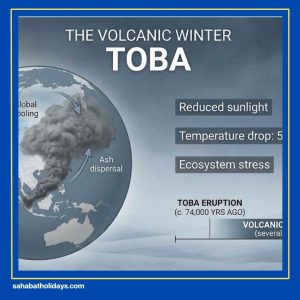
The aftermath was even more terrifying than the explosion. The ash cloud blocked the sun for years.
-
Global temperatures dropped by 3°C to 5°C (some estimates say up to 15°C in higher latitudes).
-
Photosynthesis slowed down. Plants died. Animals starved. The planet plunged into a “Volcanic Winter.”
3. The Human Bottleneck Theory

This is the most dramatic part of the history of Lake Toba. Geneticists and anthropologists have proposed the “Toba Catastrophe Theory.” They believe this eruption almost wiped out humanity.
The harsh climate conditions reduced the human population to a mere 1,000 to 10,000 breeding pairs. Every human alive today is a descendant of those few tough survivors. In a way, the history of Lake Toba is the history of us. It is the ultimate survival story.
How Samosir Island Was Formed
After the eruption, the magma chamber emptied, and the roof of the volcano collapsed, forming a massive bowl (caldera). Over thousands of years, this bowl filled with rain, creating the lake.
But the story didn’t end there. The magma chamber below was still active. It began to push the earth upward again. This pressure lifted the center of the lake floor, creating a “Resurgent Dome.” This dome rose out of the water and became Samosir Island.
This is why Samosir is so special. It is not just an island; it is the “plug” of the volcano, pushed up by the earth’s pressure. When you hike on Samosir, you are walking on land that was once at the bottom of the crater.
Also Read: Experience a Magical Lake Toba Holiday
The Human History – The Rise of the Batak
The history of Lake Toba is also the history of its people. The Batak Toba ethnic group has lived in this caldera for centuries, isolated by the high crater walls.
This isolation allowed them to develop a unique and sophisticated culture.
-
The Kings – The region was ruled by small kingdoms (Huta) led by kings (Raja). You can still see their stone furniture in Ambarita.
-
The Religion – Before Christianity and Islam arrived, they practiced Parmalim, an animistic belief system that honored the spirits of the ancestors and the forces of nature (like the volcano).
-
The Resistance – The Batak people were fierce warriors. They successfully resisted Dutch colonization for decades longer than many other parts of Indonesia. The national hero, King Sisingamangaraja XII, is a symbol of this resistance.
Visiting History – Top Sites to Include in Your Itinerary
Reading about the history of Lake Toba is fascinating, but seeing it is life-changing. Sahabat Holidays designs itineraries that take you to the exact spots where this history unfolded.
The Geopark Kaldera Toba Information Center
Located near Parapat, this is a must-visit for science lovers.
-
What to see – Interactive displays, rock samples from the eruption, and detailed maps of the caldera.
-
Why go – It helps you visualize the scale of the explosion before you cross the lake.
Huta Siallagan (The Stone Chairs)
Located in Ambarita, Samosir.
-
The History – This village contains stone chairs aged hundreds of years. This was the ancient courtroom where the King judged criminals.
-
The Story – Our guides will explain the brutal execution rituals of the past, a dark but real part of Batak history.
Mount Pusuk Buhit
On the western edge of the lake stands this active volcanic cone.
-
The Myth – According to Batak belief, the first human (Si Raja Batak) descended from heaven onto this mountain.
-
The Trek – We organize hikes to the summit. Standing there, you can see the entire caldera and feel the connection to the ancestors.
Why Experience History with Sahabat Holidays?
Understanding the history of Lake Toba requires more than a guidebook. The layers of geology and culture are complex.
When you book a tour with Sahabat Holidays, you get:
-
Storyteller Guides – Our guides are not just drivers. They are storytellers. They know the difference between “Toba Tuff” and “Andesite” rocks. They can sing the folk songs about the Fish Princess.
-
Educational Focus – We make the history accessible. Whether you are a family with kids or a geology professor, we adjust the depth of information to suit you.
-
Access to Heritage – We take you to authentic villages where you can see the history living on in the architecture and the weaving traditions.
A Landscape That Remembers
The history of Lake Toba serves as a humbling reminder of nature’s power. It destroyed the world once, but from that destruction, it created a paradise of fertile soil, cool weather, and breathtaking beauty.
When you visit, you become a small part of this ongoing history. You swim in the crater water. You listen to the songs of the survivors’ descendants.
Don’t just look at the view. Understand it.
Book Your Historical Journey Today Are you ready to walk through 74,000 years of history? Let us guide you through the Geopark.
Visit sahabatholidays.com to browse our exclusive tour packages.

